
Congratulations! Finishing a half marathon is a fantastic achievement and everyone should be super proud of themselves! Last year, runners raised over £4.2 million for charity and I expect even more will be raised this year!
No doubt that since you’ve finished you’ve been walking a little funny. Or maybe during the race you’ve picked up an injury. These things do happen, especially if it’s the first time you’ve run a half marathon. You’ve done the hard work – now let us help you!
I’ve outlined a couple of tips that you can do to help you recover and get back to running as soon as possible!
Two recent reviews by Dupuy (2018) and Guo et al. (2017) analysed over 100 studies on the different methods used to reduced Delayed Onset of Muscle Soreness (DOMs). They found the following:
Active Recovery
Luckily, this doesn’t mean that you must head out for a run just yet! A brisk ten-minute walk each day is enough to get the blood flowing in your muscles, aiding the removal of metabolites (the product of using your muscles for 13 miles!). This is unlikely to get an immediate improvement in your symptoms but is definitely the quickest way forward!
Compression garments
Compression garments are the clothes that are skin tight and hug your muscles whilst they’re suffering. And that’s exactly how they help you! Participants in the study said they felt good whilst wearing the compression garments, meaning they were more comfortable moving around. However, they do not seem to help with the removal of the metabolites, therefore unlikely to help you in the longer term.
Water immersion
I get asked a lot in clinic – what’s best hot or cold? The answer maybe a little boring and generally boils down to what you prefer!
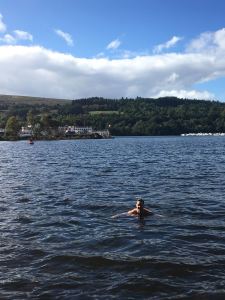
In Dupuy’s study most participants benefited most from water immersion under 15 degrees (cold!!). However, a lot of people had a good improvement in symptoms with water ranging from 15 to 38 degrees (warm).
The difference in improvements between the two groups is only small so choose what feels best to you! (Personally, I like the cold but my housemates like boiling in their bath). Unfortunately, there’s not much data on hot immersion so its difficult to advise – again go on what feels good.
BUT! Overall, most people felt their DOMs improved the most (and supported by the blood markers) when they had a massage!
Enter Osteopathy…
Massage
We understand everyone has preferences to massage, whether that being gentle and smooth, or digging in with our elbows using all our weight! (you’re crazy!) We will adapt our techniques to what you prefer and what the tissues appear to respond best to.
Become a stronger runner
After a thorough case history and assessment we can diagnose areas that maybe reducing your ability as a runner. Specific stretches, exercises, and running advice will be given to help you become a stronger, injury resistant runner!
Harry
Enjoyed this blog? See more here
REFERENCES
Dupuy, O., Douzi, W., Theurot, D., Bosquet, L., & Dugué, B. (2018). An Evidence-Based Approach for Choosing Post-exercise Recovery Techniques to Reduce Markers of Muscle Damage, Soreness, Fatigue, and Inflammation: A Systematic Review With Meta-Analysis. Frontiers in Physiology, 9, 403. http://doi.org/10.3389/fphys.2018.00403
Guo, J., Li, L., Gong, Y., Zhu, R., Xu, J., Zou, J., & Chen, X. (2017). Massage Alleviates Delayed Onset Muscle Soreness after Strenuous Exercise: A Systematic Review and Meta-Analysis. Frontiers in Physiology, 8, 747. http://doi.org/10.3389/fphys.2017.00747
 osteoharry.health.blog